It will not certify the same payment twice
Over-certification, double certification and overpayment are refused by the payment cycle itself, not caught by a report afterwards. A refusal arrives as a refusal, never as a zero.
A missed pay less notice makes the application payable in full. An extension of time you cannot substantiate is an extension you do not get. Margin erodes in the four weeks between the thing happening and the review that finds it. This platform computes all three on the day they happen — not at the month end.
One governed record from concept to the thirtieth year of operation, and every figure on it computed from that record rather than typed into it.
Real programme, real notices, real money, no signup. Or start free and book twenty minutes when you want somebody on the call.
One system across all seven, and the last of them runs for thirty years. There is no migration at handover because there is nothing to migrate to.
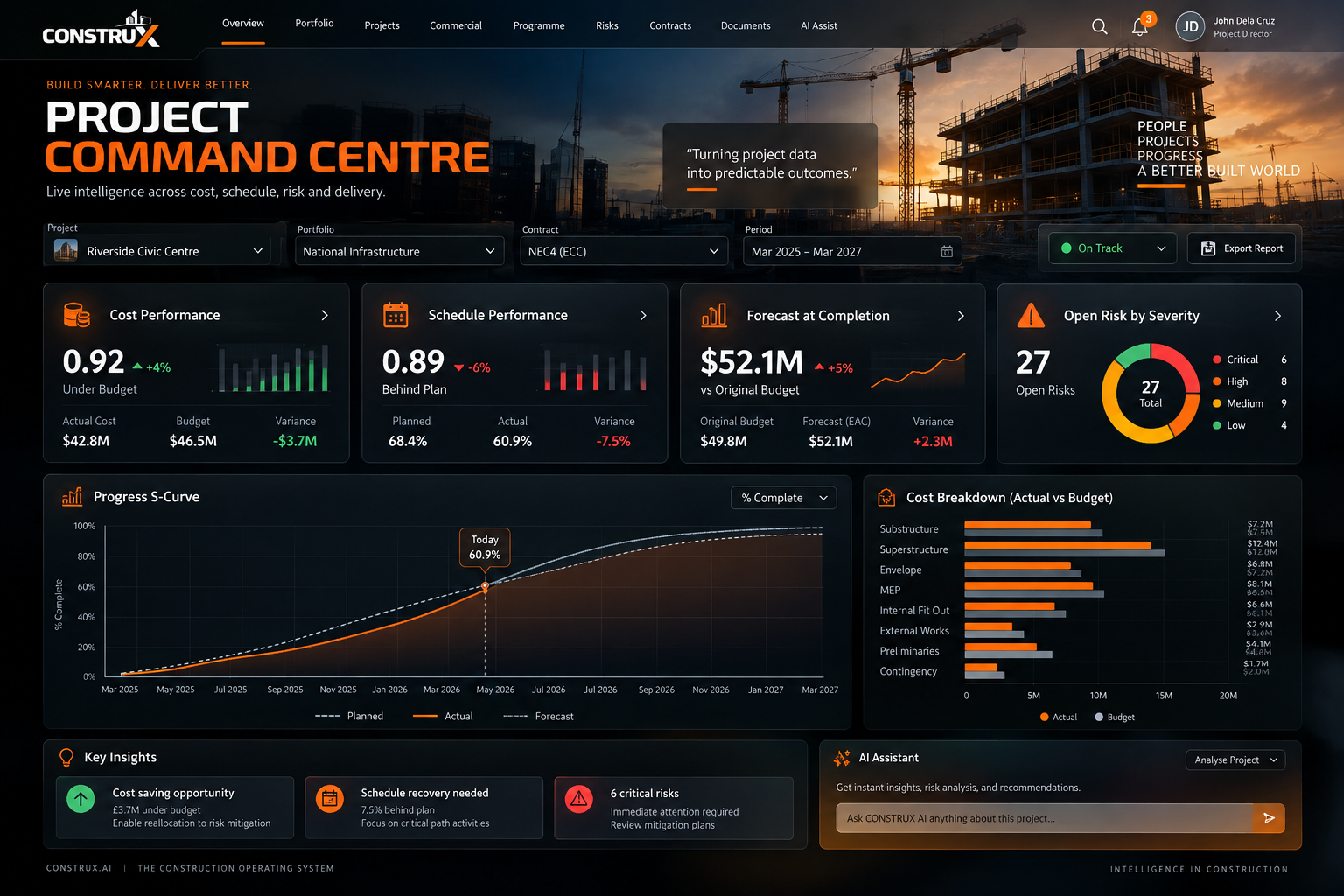
The console's shape, drawn rather than screenshotted, on the demonstration project's real name and value. The commercial and programme figures in it are an illustration — the seeded programme itself is one click away and every figure on it is computed from its own event chain.
On the demonstration project, application 3 goes in at £2,248,650. The valuation withholds £119,650 — handrail terminations not to detail, dewatering rates not agreed — and the pay less notice is served inside the window. The notified sum is £2,129,000, and the reason is on the record.
Serve that same notice two days late and the whole £2,248,650 becomes the notified sum, payable in full, whatever the valuation said. The QS finds out at the month-end review, three weeks later. The platform computes it the day the window closes, names the notice that established the sum, and states what has to be served next.
Those are the seeded demonstration project's own figures, not a customer's job, and you can open the cycle and read them. Put your own turnover into the arithmetic and it will tell you what one window is worth on your books — with no industry average anywhere in it, because we have not got one and would not print one if we had.
Of the 20 roles this platform grants, 10 hold authority — they approve money, baselines and contracts, administer people, or run the business. Those are what a package's seats are. The other 10 are participants, and a participant takes no seat at all.
And the AI a guest runs is charged to whoever agreed to pay for it — their own organisation under a consented monthly limit, or you, once, on an authorisation you gave. Never both, and never silently.
Every other platform in this market generates. The useful moments here are the ones where this one declines — because a document the system was willing to invent is a document you cannot stand behind.
Over-certification, double certification and overpayment are refused by the payment cycle itself, not caught by a report afterwards. A refusal arrives as a refusal, never as a zero.
A Construction Phase Plan missing its judgement sections cannot be approved, and while it is unapproved the platform refuses to record an induction against it. The paperwork order is the safety order.
Six of the sixteen CDM documents need a principal contractor's appointed approver. Where nobody holds that duty, those documents sit complete and unsigned rather than carrying a signature the platform had to invent.
No provider is called on an empty wallet, and no charge is taken without a ledger entry. Where a model is unavailable it falls back and says which one answered.
Of 81 agents, 2 may ever act without being asked — and only inside an envelope a person granted, with an end date, revocable, naming the exact commands. One files a tender return register; the other says the platform is unwell. Both carry a value ceiling of zero. Every other agent can only propose.
Governance events are marked closed to AI in the event catalogue itself, and an envelope naming one is refused when somebody tries to grant it. So a decision taken by a model is not a permission that was withheld — there is no path to it, whatever an agent or a future envelope attempts.
Narrative sections carry their author and whether a model or the local stand-in produced them. An assurance team asking who wrote the safety case gets a name, not a shrug.
A bill's rows come off the PDF as rows, blanks kept blank and a wrapped description joined. Two columns of prose that happen to line up, or a heading beside a date, are refused as tables rather than read into a schedule as quantities nobody measured.
A second process following the record from Postgres answers every read and refuses every write by name — sign-in included — so two processes can never each hold a different truth. Promotion is a restart, and the database refuses a second writer rather than forking.

Three things separate a record that survives a dispute from a folder that does not.
A correction is a new event and the original stays visible. Each event carries the hash before, the hash after, and a chain hash over its predecessor — so an insertion, deletion or alteration anywhere changes every hash after it and the state root along with them.
805 event types and no others. An event nothing can emit is a capability that does not exist, and a test fails if one appears. That invariant exists because a control standard once reported a missing site diary on every project — with no command able to write one.
Rebuild every entity from the log alone, verify each event independently, emit one root hash any party holding the same log can recompute. Where your policy withholds a record, the redaction is reported and the root still covers the complete record.
Not summarisation over your documents. Forward and backward pass, expected value, statutory date reckoning — computed, deterministic, and the same answer twice.

Critical path, float and PERT probability. Monte Carlo completion, corrected for merge bias.
Earned value with three EAC scenarios, CVR with margin erosion, S-curve cashflow.
The Construction Act position — which notice established the notified sum and what a missed one cost.
Expected value, P80 contingency, and thresholds proportionate to the contract rather than fixed.
Inspection and test plans with acceptance criteria, hold points witnessed rather than asserted.
Revisions, clash closeout with evidence, and clause extraction from the specification as supplied.
Reliability-adjusted maintenance forecasting against the asset the record actually describes.
What across the portfolio needs a decision this week, ranked with the reason and the exposure behind it.
RIBA Plan of Work 2020 across seven gated phases, CDM 2015 duty documents that stop the job when they are unapproved, the payment statute, ISO 19650 suitability and the golden thread the Building Safety Act expects. Not a compliance checklist bolted on — the gates are what the platform refuses on.
Every stage maps onto one of seven gated phases, and a project cannot leave a phase until the gate is met. Design maturity is assessed per discipline at its RIBA stage, and the DESIGN gate refuses to open without one.
lifecycle/phases.ts — PHASE_GATES, evaluated on every advance; DesignMaturityAssessment carries a 0–7 stage per discipline
Not claimed — This platform is not a RIBA-certified tool and does not issue RIBA deliverables. Procurement is a gated phase here and a task bar there; the mapping says so.
16 duty document types, each with the sections the regulations require, drafted against the project's own record. Construction Phase Plan gates the construction phase: unapproved, the work cannot start.
domain/cdm.ts — CDM_DOCUMENTS with required sections and the approver role; the gate refuses an unapproved plan
Not claimed — Drafting a duty document is not discharging the duty. The dutyholder approves it, and the platform records who did and when.
Due dates, payment notices, pay less notices and the notified sum, counted in days as the Act counts them. A missing payment notice makes the applied sum payable in full, and the platform says so before the date rather than after.
engines/maths/constructionAct.ts — statutory periods, with s.116(3) handled separately from service dates
Not claimed — It is not legal advice, and an adjudicator decides what a notice meant.
Every container in the common data environment carries a suitability code, and a code the standard does not define is refused. A drawing issued for comment is not a drawing to build from, and the record knows the difference.
domain/cde.ts — suitability refused with SUITABILITY_UNKNOWN
Not claimed — The platform does not certify a BIM execution plan or audit an organisation against the standard.
Every governance act is an append-only, hash-chained event with its author, its evidence and its correlation. The chain is verifiable by anybody holding the export, including after this platform is gone.
goldenthread/ — the chain; export/exporter.ts — a verifiable export; erasure keeps the safety record the Act requires
Not claimed — The Act places duties on dutyholders, not on software. This keeps the record they are required to keep; it does not make anybody a dutyholder or discharge one.
Obligations resolve to the clause that imposes them under the form the parties actually signed — notice periods, retention release, defects, extension of time, variations. Where a form has no equivalent clause the entry is absent rather than approximated.
engines/maths/contractClauses.ts — clause references per suite; an absent obligation is left absent
Not claimed — An amended standard form is the amendment, not the standard. A wrong clause reference is worse than none, because it gets quoted in a letter.
Enforced means the platform refuses the work without it — an unapproved Construction Phase Plan stops the construction phase, a design with no maturity assessment cannot leave design, a suitability code the standard does not define is rejected. Carried means the record is structured to the standard and a person still decides. Every line above is read from the module that implements it, so this page cannot claim a gate the platform has stopped enforcing.
If the payer gives no payment notice and no pay less notice, the sum applied for becomes the notified sum and is payable in full, however optimistic the application was. The platform computes that position rather than describing it: which notice established the notified sum, what a missed or invalid one has already cost in money, whether the right to suspend is open, and what has to be served next.
A term the Act makes void is replaced by the Scheme whether anybody noticed or not — so a contractor who priced for a payment period the Act strikes out has priced for a cost he does not carry. A term that is merely onerous is lawful, and stays his problem. The platform tells the two apart.
And it invents nothing. Statutory interest runs at base rate plus 8%; the base rate is a fact about the outside world this platform is not connected to, so the entitlement is stated and the amount is not.
CONSTRUX comes out of Justin Nseya's years as an MCIOB construction professional and senior project-management leader — and out of the same failure, met on project after project.
Design, programme, cost, procurement, contracts, delivery, commissioning and handover were each managed competently, and each in a different system. Every one of them was fine on its own. What did not exist anywhere was the join — so information arrived late rather than missing, risks were found after they had already become variations, and the most expensive people on the project spent their time chasing updates instead of controlling delivery.
That is not a people problem and no better version of any one of those systems fixes it. It is structural: there was nowhere that recorded what happened once, at the moment it happened, in a form every discipline could read.
That is not a reassurance. It is three properties of the record, and you can test all three before you pay us anything.
Which is also the answer to the question behind it: an evidence trail whose truth depends on the supplier still trading is not an evidence trail. It is a subscription.

A trial governs, records and computes. No card, no call, no sales qualification step.